The Jevons Paradox: Why AI Won’t Kill Software Engineering
Overview
“White collar roles are dead”. That seems to be the common theme for most of the stuff I see on LinkedIn, Medium and anywhere else that likes to fear monger. I get it: AI is confronting, and is unlike anything we have seen before. These titles honestly annoy me because they are click-baity and sometimes lack substance. By that, I mean the content of these posts generally is unfounded and misses a whole heap of information. Let me give you an example. You may see a post claiming that a leading SaaS platform is no longer needed, because Little Johnny was able to vibe code a replacement in 8 hours. Or, Little Jane doesn’t need to work anymore because she has an army of agents to do everything her role requires. Congratulations, you solved the meaning of life! Little Johnny’s app works perfectly fine on localhost, and Little Jane was most likely going to be made redundant anyway!
So let’s get serious for a minute. AI will, no doubt, change society. It already has in many ways. Cutting code? Seamless with agentic AI using tools like agent skills and MCP servers. Doing mundane tasks on your behalf via a device? Yep, OpenClaw revolutionised that and now there are a heap of players on the market. There is no getting away from it. Things will (and have) changed.
It does beg the question though: is my job safe? That depends on the unique value you bring to your role and how well you can adapt. The good news is it’s not all doom and gloom. In fact, those who embrace AI tooling and use it to their advantage may find themselves in surprisingly high demand. Enter the Jevons paradox.
What is Jevons paradox?
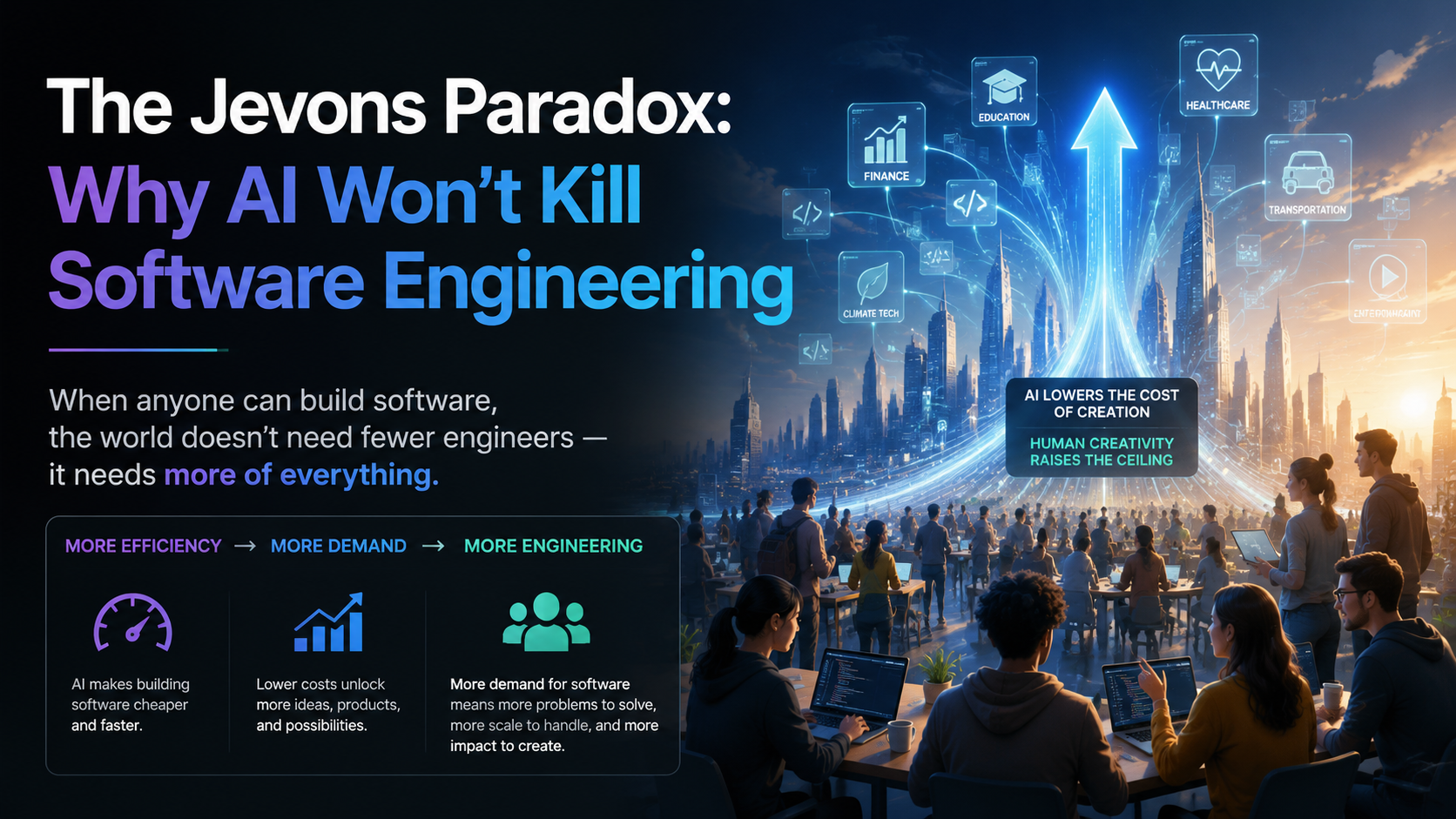
Jevons paradox describes a technological advancement that makes a resource more efficient to use. Rather than demand for that resource dwindling as a result, it actually increases — in an unexpected and counter-intuitive way. The term was coined by English economist William Stanley Jevons, whose example related to coal consumption. When a more efficient steam engine was introduced, coal usage didn’t fall — it rose, driven by the new applications the inventor made possible.
A similar pattern is unfolding with the AI era. Most people expect roles to be completely automated. While this may eventually happen, in the short term (say for the next 5 years), demand for AI will increase. With this, demand for AI skills will also increase. This will have an effect on all white collar roles, where some new roles will be created, some roles will morph into something new, and some roles will completely disappear.
Jevons paradox and the IT industry
The barrier to entry for software creation has never been lower. You can now prompt into existence any type of software that you can imagine, articulate and explain. AI models will build it for you in a significantly shorter timeframe than any other software like it. Whether it’s enterprise-grade software is another story entirely. Anyone can prompt anything now, but it doesn’t make it the next big thing because you can run it locally.
Having said all of this, software can now be much more bespoke than it ever was. Take for example a small marketing company who need very specific software for their use case. They can purchase a custom product from a well-known vendor, pay a monthly fee, hit 90% of their use case and be happy. What if, instead of paying for this software, they created it themselves internally? Sure, perhaps most of it is vibe coded and perhaps management of the software is less than ideal, but what if a prototype is built, showcased to the board/C suite level and a business case is approved? A vibe coded product that hits 100% of their use case, and can be further developed internally by proper software engineers means that there will be much more opportunity on the market for those skills.
Instead of AI taking all of the jobs, it may actually rapidly grow the IT sector with new jobs. Software engineers are but a specific discipline in the IT machine. What about infrastructure, security, management. Not to mention, this could be one of several products that are maintained internally. It does make you think about what really will happen next.
SaaS disruption
SaaS has been a dominant player in the market for many years. Ever since we transitioned from software installed locally to web-based SaaS, it has never gone back. Can you even remember the last time you installed something locally? I’m not talking about installing a package via brew, npm or chocolatey. I’m talking about getting media in whatever form is standard nowadays, installing it, and running it. It just doesn’t happen.
There is a change though happening with SaaS, and it ties in with the previous section. Software creation is simple now as we’ve covered. If you’re able to produce something functional and host it within your datacentre or cloud environment, the cost for subscribing to the SaaS equivalent stops. Yes, that cost may transition to paying a FTE to maintain the product. But, if it works out financially for the company, it’s a compelling idea. You’re already seeing this happen in the market. The most recent example is Atlassian laying off 1600 employees in March of 2026. The official stance from Atlassian is a mixture of AI enhancement, a changing landscape (ain’t that the truth), and more importantly, revenue generation. SaaS companies are very afraid of the new AI age, and rightfully so.
Lean into AI, now
As of this post in June of 2026, I have recently started a new role. In my previous role as a consultant, almost everything we talked about was AI related. Conversations would consist of the latest model, a new update to an existing harness, what wacky project someone hatched over the weekend while they had a spare couple of days. The conversations were endless. The best part about all of this was genuine excitement and solid use cases for products that were actually damn impressive. One colleague in particular had developed a bot that could perform QA testing on applications, end to end. It may not sound like much, but it’s quite significant in the software field to have this process completely automated and evolve just with prompts.
The crux of the point I’m trying to make here is that now is the time. Not tomorrow, not next week, not “when I get a sec”. It’s now. If you are just using the web prompters for ChatGPT and Claude, it’s time to shake it up. Install a harness (Claude Code, Co-Pilot, Codex) and start playing with its agentic capabilities. It costs money? Pittance compared to what it can do for you. It’s worth it. You don’t need to get fancy and have an army of agents with personas. Give it instructions as if you were explaining it to someone who was doing a task for you. The better the prompt with rich detail, the better the result you will get. Learn about how agents work, how they use tools, learn what MCP is (albeit that it may not be a thing that is used long term) and learn about agent skills. Hit that moment where you stop and realise “holy shit, this is actually legit”. The way things were done previously are still possible, but AI will make things easier. It is key that you understand how they work because I can assure you, if you don’t learn the tools now, someone who does know the tools will threaten your job. That’s Jevons paradox in action — the easier software becomes to build, the more of it the world will demand, and the more it will need people who actually know what they’re doing.
Change is necessary
If you decide that AI isn’t for you, and you’re fine to continue to do what you’ve done for the last X amount of years during your career, expect some friction in the future. AI will evolve naturally, and within the next few years, we may see a completely different way of working. It could be that the agentic way of working will change to something else. If it does, great! Something new to learn and to figure out. As we get older, it gets harder to stay current on some topics. However, we don’t have the luxury of our forefathers doing the same thing day in day out for our entire careers until we hit our late 60s. Honestly, I don’t know about you, but that excites me. Learning something new doesn’t mean a drastic change, it’s incremental. The AI uptake is not a difficult one. It literally is a prompter that you interact with as if you were speaking with someone else and giving specific instructions to. There are techniques to prompting and the more you do it, the better you will get at it.
If all else fails, then I wish you luck and hope that you have a plan b.
How to remain valuable
Coming back to Jevons paradox, the potential for growth and opportunity still exists. However, it is not as simple as the opportunities will simply fall into your lap. There needs to be effort applied. It’s unfortunate, especially if you really don’t like change. But, that is the reality we find ourselves in. Amongst all of this, you may ask yourself during this AI era “how do I stay valuable? What does my employer value about me for them to keep me around?” It’s actually a pretty straightforward answer. What makes you valuable are several key aspects:
- Domain knowledge: Understanding your industry and how it works.
- Critical thinking: Does an AI model know the business and its visions like you? Doubtful.
- Problem solver: This will stand the test of time. Always be curious and challenge yourself.
- Deep understanding: AI is a tool at the end of the day. In some capacity, you need to understand what it’s doing. Don’t YOLO and hope for the best.
- Accountability: AI won’t take this away from you. Like the deep understanding attribute, AI is a tool that you use. If you aren’t confident in what it provides, then take another approach.
If you have even one or two of these attributes, then you are still valued. Coupled with AI tooling, you’ll be more than capable of pushing forward and showing that you belong when AI uptake starts in your field or company.
Don’t shy away from AI, lean into it, embrace it, and get prompting!
Cover image by notegpt.io